

















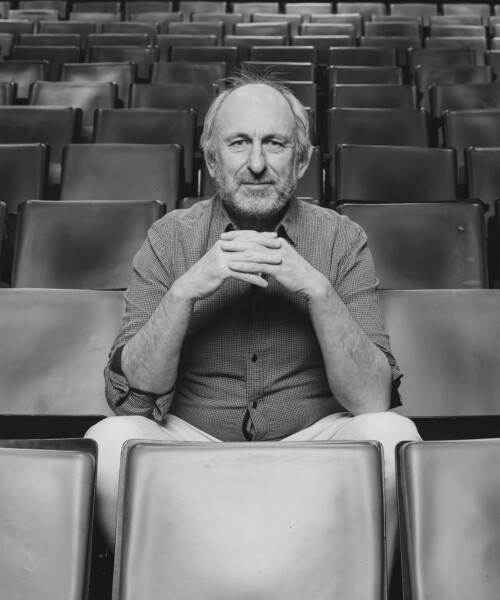
The actor and playwright David Cale has had a busy few months.
After a rave review in The New York Times, his monologue Blue Cowboy was extended again and again at the Bushwick Starr last fall. Cale starred as a version of himself, a writer who has an affair with a closeted local during a trip to Ketchum, Idaho.
Cale also shows up in the movie The Testament of Ann Lee as John Hocknell, one of the original Quakers who came to America in the 1700s.
His latest play The Unknown just opened to a lot of buzz at Studio Seaview where it plays thru mid April. Sean Hayes stars in the one-man show as a writer who thinks he’s being stalked.
Here, Cale, whose Talented Mr. Ripley-like monologue Harry Clarke is available to listen on Audible (starring Billy Crudup), talks about the busy time.
What inspired you to write The Unknown?
In the early part of my career I only worked on my own shows and occasionally acted in films. I’d never acted in a play and received a call to audition for one directed by a stage director I admired. The play was brilliant, and I did the audition. As I didn’t have an acting agent, I called the casting director who’d contacted me in the first place. I wasn’t asking or wanting any feedback from the audition, I just wanted to know if any decision had been made. The casting director told me what the director thought and it was such a cruel, dismissive appraisal of my worth as an actor and also, in a way, my specialness as a person. It was awful. I’m resilient, but it was the kind of remark that could devastate a less stable person and certainly make them give up pursuing an acting career. So, that was the original basis for the idea for The Unknown—an emotionally damaging remark made to an actor who was being rejected for a role and that unstable actor seeking revenge. The plotline of The Unknown shifted from that, but that was the initial inspiration.
What’s the impetus for you to start writing a new monologue/theater piece?
I usually start with an event that has intrigued me or emotionally engaged me, either imagined or something that happened to me, something I’m going through or I witnessed. I then imagine what would come next or just dramatically explore what actually came next. All of my shows are emotionally autobiographical. Some are factually autobiographical or parts are factually autobiographical. They’re all some form of self-expression, so as soon as I start writing, and I write very intuitively, some of myself goes into every story.
How do you decide when you’re going to perform a show yourself or have another actor do it?
The Unknown is the third of my shows that I didn’t perform. With Harry Clarke, the first of the three, it wasn’t an option. Audible, the producer, didn’t want me to perform the piece. They wanted someone more widely known for their first venture into theater. So with that I didn’t have a choice, except choice of actor, and my first choice was Billy Crudup, who very happily accepted and was beyond brilliant in the show, and that all certainly worked out. With Sandra, the second show, I considered performing it myself, but it was written for a woman, and that decided it for me, and I wanted Marjan Neshat, who played the role. Leigh Silverman, the director of all three of the shows I didn’t perform, sent Sean Hayes the first seventeen pages of The Unknown, which was all there was at that point. Sean was interested to know what happened next. I wrote the remainder of the script and met with the two of them, initially about the script being the basis of a film I’d write, Leigh would direct and Sean would star in. By the end of our lunch, Sean wanted to perform the show on stage. It was such an exciting idea to me that I didn’t even consider performing The Unknown myself.
Why do you think Sean Hayes is a good fit for this role? Or even a better fit than you are yourself?
I love out-of-the-box casting. So the idea of Sean, who’s such a charismatic, immediately likable person who you automatically trust, playing someone who, at a certain point in the story you begin to question their trustworthiness or state of mind as the narrator, was interesting to me. I didn’t think of who would be a better fit.
How did your role in The Testament of Ann Lee come about? What was that experience like?
Mona Fastvold, the director/co-writer of the film, and Brady Corbet, her partner and the co-writer of Ann Lee, are friends of mine. I’d read an early draft of the screenplay. Mona and Brady saw me perform my solo musical memoir, We’re Only Alive for A Short Amount of Time at The Public Theater in NYC, and offered me the role via text from Hungary, where they were preparing the film. It came to me as a complete surprise. Working on the film was one of the most extraordinary and spiritual experiences I’ve had. It’s the greatest gift I’ve ever been given.
Will we hear from Harry Clarke again?
I certainly hope so. Either on stage or in a film.
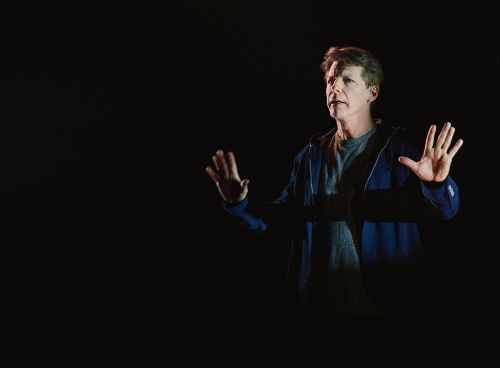
Sean Hayes in The Unkown (Emilio Madrid)