

















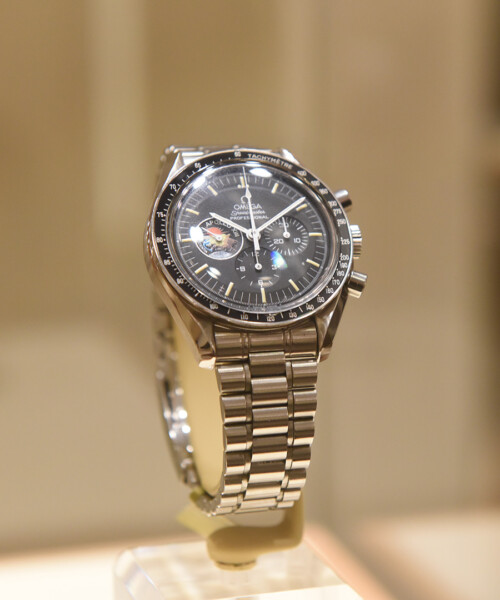
Christie’s auction house in New York is gearing up for a sale tomorrow evening of 50 prime specimens of the Omega Speedmaster—the iconic watch that’s probably most famous for helping bring the crew of Apollo 13 safely back to Earth. The watch, which has been worn of the wrists of astronauts during six lunar landings, is credited with saving the mission when the crew used it to time a critical 14-second-burn of their engines, correcting an otherwise catastrophic re-entry trajectory.
When Omega debuted the first Speedmaster, in 1957, as part of its new “Professional” line of watches, very few chronographs—a traditional display timepiece with a stopwatch function—were being made. Despite the ubiquity of chronographs today and their popularity among people in just about any industry, they were originally designed as purpose-oriented tools for physicians, engineers, Olympic coaches and the like. The 1957 Speedmaster, created with racecar drivers in mind, went a step further—the world’s first chronograph to feature a metric scale, namely its “Tachno-Productometer scale” (T.P.M.). Etched into the rim of the case, it allows for even greater time-measurement accuracy.
Since the Speedmaster’s introduction on the market, its popularity has grown exponentially, garnering a cult of fanatic collectors and casual admirers alike.
Speaking to its storied past and flock of enthusiasts, Omega’s Museum Manager, explains, “Born as a high quality chronograph for car drivers, it went into space even before NASA’s official qualification, it flew on America’s first space walk, landed and walked on the moon, often providing those remarkable men, NASA’s astronauts and heroes with their only visible—ticking if you will—link to home. And it helped save their lives during the Apollo 13 mission.”
Touted in Omega advertisements from 1957 as a “high-precision wrist computer,” the original model boasted then-groundbreaking features such as an anti-magnetic, shock-proof, triple-sealed case, water resistant up to 200 feet. In other words, the watch wasn’t just about looking great—it meant business.
Bidders at the upcoming Christie’s auction, “From a Spacewalk to Today,” are expected to keep their eyes on a few particularly exceptional lots. The standout pieces include an extremely rare first-generation Speedmaster in pristine condition (lot 3); a watch owned and worn by the decorated British WWII pilot Captain John. W. Hackett (lot 10); and Apollo 17 astronaut Ron Evans’ own Speedmaster (lot 15).
Main image by Diane Bondareff