




















Henrik Stigell does not paint places as they appear. He paints them as they remain.
Based in Sweden, the painter has built a body of work that moves deliberately between landscape and interior space, abstraction and representation, without settling fully into any of those categories. His paintings resist easy description. They are pared back, layered, and restrained, yet emotionally charged. What they offer is not an image to decode but a condition to enter—one shaped by time, memory, and sustained attention.
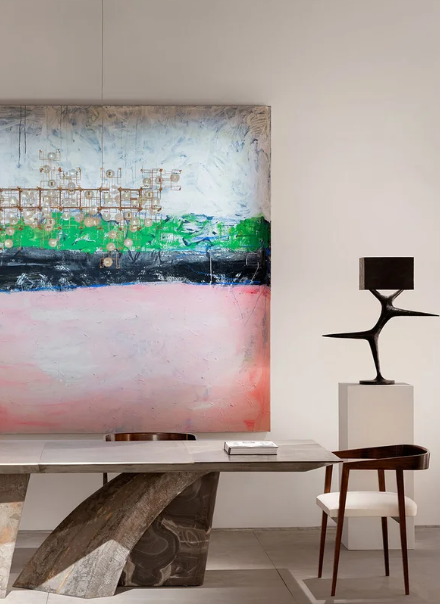
Stigell’s work reflects a long-standing interest in how environments are experienced rather than observed. A horizon line may appear, but it is softened, partially erased, or obscured by successive layers of paint. An interior space may be suggested through shifts in tone or geometry, yet never fully articulated. These are not depictions in the traditional sense. They are accumulations—of gesture, material, and duration.
The surfaces of his paintings carry much of their meaning. Built slowly over time, each canvas retains traces of its own history. Earlier layers remain visible beneath later ones, creating a sense of depth that is less spatial than temporal. The paintings feel worked through rather than resolved. This openness is intentional. Stigell allows time and material to play an active role in shaping the final image, resisting the impulse to overwrite or finalize too quickly.
Color is handled with similar restraint. His palette draws from the subdued tonal range often associated with Nordic light—cool greys, muted blues, pale earth tones, and softened whites. These colors do not function decoratively. They establish atmosphere, registering emotional states rather than describing physical features. Light in Stigell’s work is diffuse and indirect, closer to memory than observation.
Despite their quiet appearance, the paintings are not neutral. They carry a sense of emotional density that emerges slowly. The longer one spends with them, the more apparent this becomes. Subtle shifts in tone begin to register. Buried gestures surface. What initially reads as minimal reveals itself as layered and deliberate.
Stigell’s process is central to this effect. His approach is slow and methodical, shaped by repetition and revision rather than spontaneity. He works without haste, allowing each layer to dry, settle, and assert itself before continuing. This method reflects a broader sensibility within his practice—an insistence on giving time its due, both in the making of the work and in how it is encountered.
This emphasis on duration sets Stigell apart in a contemporary art landscape often driven by immediacy and visibility. He exhibits selectively, favoring independent art spaces over institutional platforms. His work circulates quietly, finding its way into private collections rather than large-scale commercial channels. This limited exposure is not strategic so much as consistent with the nature of the work itself, which resists spectacle.
There is a strong alignment between Stigell’s practice and a broader movement toward material intelligence and considered making—an approach that values depth over display. His paintings share a sensibility with spaces such as Carpenters Workshop Gallery, where craft, process, and conceptual rigor intersect, and where objects are valued for their ability to sustain long-term engagement rather than immediate impact.
What ultimately distinguishes Stigell’s work is its refusal to dictate experience. The paintings do not instruct the viewer on what to see or feel. Instead, they create conditions in which attention can unfold. They reward slowness. They allow room for uncertainty. Meaning is not delivered but gradually assembled through sustained looking.
In a cultural moment defined by acceleration, Stigell’s paintings offer an alternative proposition. They suggest that environments—whether landscapes or interiors—are not static backdrops but living presences shaped by time and use. His work asks what remains after a place has been left, after light has shifted, after memory has softened detail.
Henrik Stigell’s paintings do not demand attention. They wait for it. And in doing so, they remind us that some experiences only reveal themselves when we are willing to stay.