Corey Stoll’s Quiet Power Play
by Natasha Wolff | May 3, 2026 9:55 am
Tony season is in full swing uptown, but downtown, at the Audible’s Minetta Lane Theater[1], Corey Stoll[2] and Cecily Strong are starring in a gem of a revival of Tom Noonan’s 1992 play What Happened Was…[3]. The premise is simple: two law firm colleagues, Michael and Jackie, meet at Jackie’s house for dinner. Jackie thinks it’s a date. Michael’s on his own planet. They eat microwaved scallops. They listen to some Joni Mitchell. Jackie reads a chapter of a weird book she’s writing, and you’ve got one of the best plays of the season. Here, Stoll, currently appearing in Imperfect Women[4] on Apple, talks about the play.
What drew you to this particular play and this character? Had you known about it before?
I hadn’t seen or read the play or the movie before. In fact, I still haven’t seen the movie— I wanted to approach the role without being unduly influenced. To be honest I didn’t really get the play on first reading. I didn’t understand the tone or the character’s motivations. But there’s a tenderness and sincerity to the play that I found refreshing and compelling. When I met with our director Ian Rickson, he told me the origin story of the play: Tom Noonan had been playing all these bad guys in movies and had developed a nervous facial twitch and wasn’t able to be on camera, so he focused on writing. As someone who has played a lot of bad guys I identified with him. Don’t get me wrong, villains can be very fun to play, but that cynicism and cruelty take a toll. It’s been a joyful experience to play someone so sincere and curious.
Where were you in 1992 when this play is originally from? Did you care about the theater then? Did you think you’d be an actor?
In 1992 I was a high school sophomore at LaGuardia High School for the Arts here in Manhattan. Somehow, I had the self-awareness (or arrogance) to know I was going to be an actor. In fact, I remember saying at the time that I WAS an actor— that I didn’t need someone to pay me to act to hold that identity. I was very lucky to go to lots of theater in New York from an early age. I was decidedly uninterested in musicals, but I was obsessed with off and off-off Broadway productions. Much of it went over my head, but I had an insatiable appetite for it. Fame was not the goal, nor did I think it was likely. I wanted to be known and respected enough to keep working.
How do you think this piece plays differently in 2026 than when it was written?
I think the play is pretty timeless. Unfortunately, loneliness and alienation don’t go out of style. I do think awareness of gender roles has shifted. There are moments when my character appears to be mansplaining when I can feel the audience turn against me. But what I love about the play is that the audience is constantly making judgments about these characters that are then subverted.
What’s it like doing a two-hander with Cecily Strong?
I feel so lucky to have Cecily as a partner. I was only familiar with her work on SNL, which was brilliant and hilarious. Her “Girl You Wish You Hadn’t Started A Conversation With At A Party” character and Jeninne Piro are all-time classics. But she has just as much access to pathos as to humor. She seems incapable of playing a false moment. Like playing tennis with a great player, she makes me better.
Talk to us a little bit about that amazing scene where you listen to her read the first chapter of her book. It’s so much about reacting.
I remember first reading that story and thinking it would be difficult to stay present throughout it for every performance. But it’s been such a joy and a privilege every time. It’s such an insane story, and she tells it so well, fully present, and seeming to find new things every time. The audience can get kind of wild during that speech, often out of discomfort, so I see my job as helping to keep the focus on the story and Cecily.
What are the benefits of doing a short run like this?
Taking on a long run changes the calculus in terms of risk-taking. If you know you’re going for months and months of eight shows a week, you’re going to want to know it’s going to be great. This can lead to making safer choices in roles and projects. As I said, I didn’t entirely get this play or this character when I signed on. There was a very real chance that it wouldn’t work, that I wouldn’t be well-cast, or that audiences would be dumbfounded by it. But because it was a short run, and we’re not doing a grueling eight-show week, I figured it was worth the risk. I think it’s turned out great, and audiences seem to really be connecting with it, but it certainly wasn’t a given.
Do you imagine Michael and Jackie go on another date?
Apparently, Tom wrote a sequel that takes place 17 years later. They married, had a child and immediately divorced. No one can find that play, but I hope someone does. I’d love to read it.
What’s something you’re recommending to people now to read, watch or go see?
I’m not a reality TV guy, but I’ve been watching Love on The Spectrum. I can only watch one episode at a time. I find it so emotionally overwhelming. And I’ve been on a Lauren Groff jag. I’ve read four of her books this year. I am currently reading Florida, a short story collection from a few years ago. She writes equally beautifully about both the spiritual and the profane.
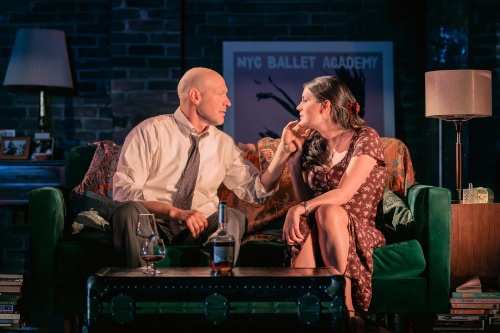
Corey Stoll and Cecily Strong in What Happened Was
- Audible’s Minetta Lane Theater: https://audiblexminetta.com/
- Corey Stoll: https://dujour.com/culture/corey-stoll-ant-man-interview/
- What Happened Was…: https://audiblexminetta.com/shows/what-happened-was
- Imperfect Women: https://tv.apple.com/us/show/imperfect-women/umc.cmc.1w2rmpbqzt24879bt7109zgi6
Source URL: https://dujour.com/culture/corey-stoll-what-happened-was/